Monday, November 7, 2016

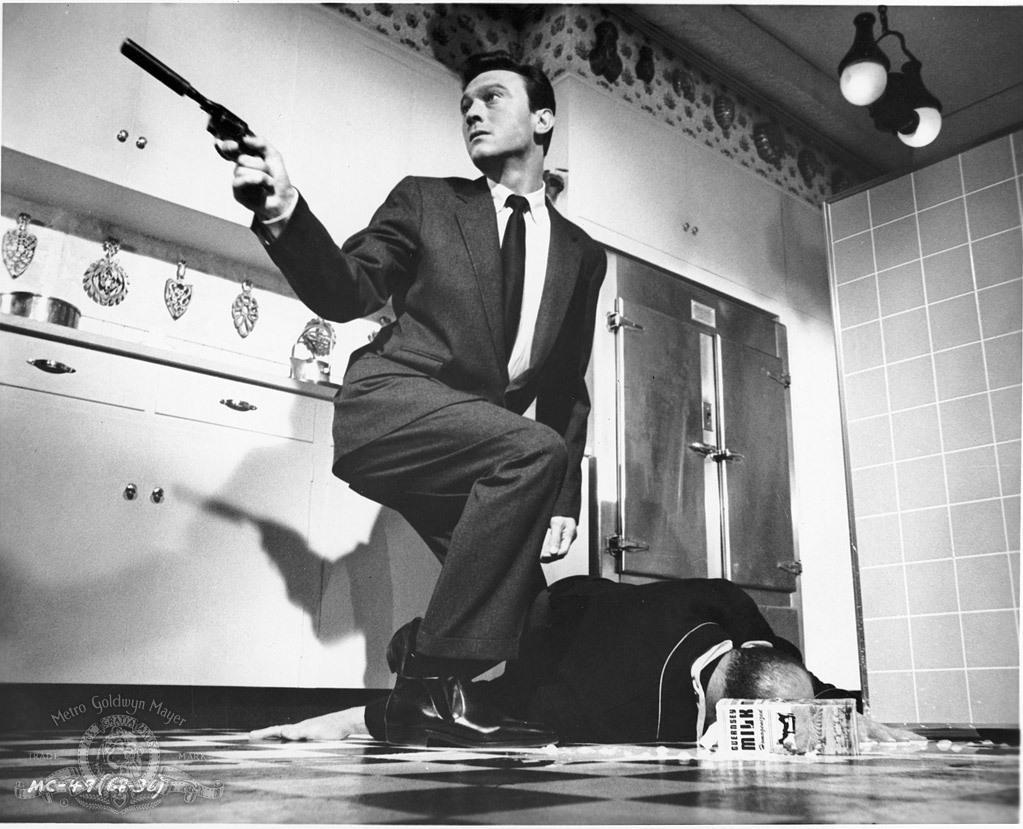
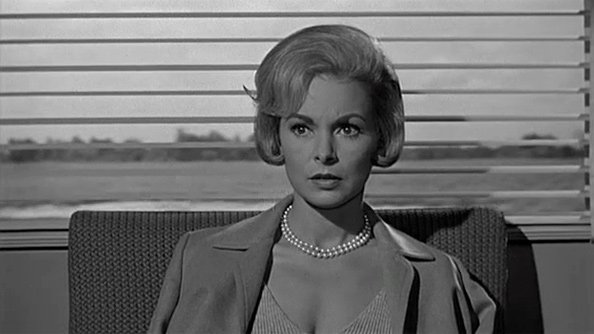
The Manchurian Candidate

Laurence Harvey
The count down is on! Tomorrow is the big day--election day, so be sure to vote! I don't know about you, but I'll be happy when the big day has come and gone! 

However, if you're caught up in the season and really enjoy all things politics, you'll probably like the movie The Manchurian Candidate. I'm referring to the 1962 version. I rented it years ago and found it absorbing and quite fascinating. Like Citizen Kane, it's one you have to watch from the beginning and pay close attention. Filmsite Movie Review says: 

The Manchurian Candidate (1962) is director-producer John Frankenheimer's prophetically tragic, chilling, brilliant, blackish (film-noirish) Cold War thriller about brain-washing, conspiracy, the dangers of international Communism, McCarthyism, assassination, and political intrigue. Laurence Harvey is brilliant as a brainwashed Korean war hero who has been programmed as a Soviet sleeper/mole agent to assassinate a Presidential candidate. It can be categorized within many film genres - it functions as a horror film, a war film, a science fiction film, a black comedy, a suspense-thriller, and a political melodrama (with additional segments of romance and action).
Janet Leigh

The mood of this pseudo-documentary, satirical film masterpiece (from prolific veteran television director Frankenheimer) is paranoic, surrealistic, dark, macabre, cynical, and foreboding - these elements are combined in a traditional, top-notch suspenseful thriller framework with a nail-biting, Alfred Hitchcock-like climax. The movie displays the emerging role and importance of television in broadcasting public affairs and shaping opinion, and the circus atmosphere that surrounds American politics.

Read the complete review here. This film is considered by many critics to be one of the best movies ever made. Have you ever seen it?

Thanks for visiting and have a great week!

Monday, October 31, 2016

Six Ways to Hook Your Reader!

I visited Write it Sideways and found a great article by Suzannah Windsor Freedman on how to hook your reader from the very first line. Hope this comes in handy for any writers out there!
Although I consider myself an avid reader, I must admit I have a short attention span when it comes to getting into books. If you fail to grab my attention in the first few lines, I start spacing out.
Most readers are like me. Most people don’t want to spend the first 50 pages trying to get into a book.
Here are a few things I find annoying in the first lines of a story:
  • Dialogue. Nice somewhere on the first or second page, but not in the first line. We won’t know who’s speaking or why we should care.
  • Excessive description. Some description is good, but not when it’s long winded. Skip the purple prose and opt for something more powerful.
  • Irrelevant information. The first few lines of your story are crucial, so give your reader only important information.
  • Introducing too many characters. I don’t like to be bombarded with the names of too many characters at once. How are we supposed to keep them straight when we don’t know who’s who?
The last thing you want to do as a writer is annoy or bore people. Instead, try one of these 6 ways to hook your readers right off the bat:
(N.B. One of the easiest ways to check out the opening pages of nearly any book you want is with the ‘Look Inside!‘ feature on Amazon.com.)

1. Make your readers wonder

Put a question in your readers’ minds. What do those first lines mean? What’s going to happen? Make them wonder, and you’ll keep them reading.

2. Begin at a pivotal moment

By starting at an important moment in the story, your reader is more likely to want to continue so he or she can discover what will happen next.
  • “It was dark where she was crouched but the little girl did as she’d been told.” ~Kate Morton, The Forgotten Garden
  • “I became what I am today at the age of twelve, on a frigid overcast day in the winter of 1975.” ~Khaled Hosseini, The Kite Runner
3. Create an Interesting picture

Description is good when it encourages people to paint a picture in their minds. Often, simple is best so it’s the reader who imagines a scene, instead of simply being told by the author.
  • “Last night I dreamt I went to Manderley again.” ~Daphne DuMaurier, Rebecca
  • “She stands up in the garden where she has been working and looks into the distance.” ~Michael Ontaatje, The English Patient

4. Introduce an intriguing character

The promise of reading more about a character you find intriguing will, no doubt, draw you into a story’s narrative. Most often, this is one of the main characters in the book.
  • “I was born twice: first as a baby girl on a remarkably smogless Detroit day in January of 1960; and then again, as a teenage boy, in an emergency room near Petoskey, Michigan, in August of 1974.” ~Jeffrey Eugenides, Middlesex

5. Start with an unusual situation

Show us characters in unusual circumstances, and we’ll definitely be sticking around to see what it’s all about.
  • “They had flown from England to Minneapolis to look at a toilet.” ~Nick Hornby, Juliet, Naked
  • “Last night, I dreamt that I chopped Andrew up into a hundred little pieces, like a Benihana chef, and ate them, one by one.” ~Julie Buxbaum, The Opposite of Love

6. Begin with a compelling narrative voice

Open your story with the voice of a narrator we can instantly identify with, or one that relates things in a fresh way.
  • “As I begin to tell this, it is the golden month of September in southwestern Ontario.” ~Alistair MacLeod, No Great Mischief
  • “I am ninety. Or ninety-three. One or the other.” ~Sara Gruen, Water for Elephants
No matter how you start your book, keep your readers in mind. What will make them want to continue reading? What will potentially make them put down your book?
How does your favourite book open, and what makes it so compelling?
 Thanks for visiting and have a great week, and thank you, Suzannah Windsor Freeman, for a great article! 

Monday, October 24, 2016

Citizen Kane

Last week I listed some of my favorite political movies. This week I thought I'd focus on one in particular, Citizen Kane, considered  to be one of the greatest, if not THE greatest movie ever made! I love the story, the acting and the cinematography.

William Bayer, in his book The Great Movies, says, "Citizen Kane is a version of Faust, the story of a man who gains the world and loses his soul... Orson Welles has said that Citizen Kane is a 'portrait of a public man's private life,' and that may be the best summary of all."

Bayer explains that Citizen Kane is about William Randolph Hearst, not literally, of course, but in the form of a fictionalized fantasy produced with the intention of exploiting public interest in a controversial man... One of the most delightful things about Citizen Kane is the way it uses Hearst against himself. Citizen Kane exploits him the way his papers exploited everyone else. Citizen Kane is yellow journalism. It sacrifices the truth about Hearst for the sensational aspects of his story."  

Never seen the movie? Here's some information from Wikipedia:

Citizen Kane is a 1941 American mystery drama film by Orson Welles, its producer, co-author, director and star. The picture was Welles's first feature film. Nominated for Academy Awards in nine categories, it won an Academy Award for Best Writing (Original Screenplay) by Herman J. Mankiewicz and Welles. Considered by many critics, filmmakers, and fans to be the greatest film of all time... It topped the American Film Institute's 100 Years ... 100 Movies list in 1998, as well as its 2007 update. Citizen Kane is particularly praised for its cinematography, music, and narrative structure, which were innovative for its time.

The quasi-biographical film examines the life and legacy of Charles Foster Kane, played by Welles, a character based in part upon the American newspaper magnate William Randolph Hearst, Chicago tycoons Samuel Insull and Harold McCormick, and aspects of Welles's own life. Upon its release, Hearst prohibited mention of the film in any of his newspapers. Kane's career in the publishing world is born of idealistic social service, but gradually evolves into a ruthless pursuit of power. Narrated principally through flashbacks, the story is told through the research of a newsreel reporter seeking to solve the mystery of the newspaper magnate's dying word: "Rosebud."

Here's the synopsis, courtesy of Wikipedia:


In a mansion in Xanadu, a vast palatial estate in Florida, the elderly Charles Foster Kane is on his deathbed. Holding a snow globe, he utters a word, "Rosebud", and dies; the globe slips from his hand and smashes on the floor. A newsreel obituary tells the life story of Kane, an enormously wealthy newspaper publisher. Kane's death becomes sensational news around the world, and the newsreel's producer tasks reporter Jerry Thompson with discovering the meaning of "Rosebud".
Thompson sets out to interview Kane's friends and associates. He approaches Kane's second wife, Susan Alexander Kane, now an alcoholic who runs her own nightclub, but she refuses to talk to him. Thompson goes to the private archive of the late banker Walter Parks Thatcher. Through Thatcher's written memoirs, Thompson learns that Kane's childhood began in poverty in Colorado.
In 1871, after a gold mine was discovered on her property, Kane's mother Mary Kane sends Charles away to live with Thatcher so that he would be properly educated. While Thatcher and Charles' parents discuss arrangements inside, the young Kane plays happily with a sled in the snow outside his parents' boarding-house and protests being sent to live with Thatcher.
Years later, after gaining full control over his trust fund at the age of 25, Kane enters the newspaper business and embarks on a career of yellow journalism. He takes control of the New York Inquirer and starts publishing scandalous articles that attack Thatcher's business interests. After the stock market crash in 1929, Kane is forced to sell controlling interest of his newspaper empire to Thatcher.
Back in the present, Thompson interviews Kane's personal business manager, Mr. Bernstein. Bernstein recalls how Kane hired the best journalists available to build the Inquirer's circulation. Kane rose to power by successfully manipulating public opinion regarding the Spanish–American War and marrying Emily Norton, the niece of a President of the United States.
Thompson interviews Kane's estranged best friend, Jedediah Leland, in a retirement home. Leland recalls how Kane's marriage to Emily disintegrates more and more over the years, and he begins an affair with amateur singer Susan Alexander while he is running for Governor of New York. Both his wife and his political opponent discover the affair and the public scandal ends his political career. Kane marries Susan and forces her into a humiliating operatic career for which she has neither the talent nor the ambition.
Back in the present, Susan now consents to an interview with Thompson, and recalls her failed opera career. Kane finally allows her to abandon her singing career after she attempts suicide. After years spent dominated by Kane and living in isolation at Xanadu, Susan leaves Kane. Kane's butler Raymond recounts that, after Susan leaves him, Kane begins violently destroying the contents of her bedroom. He suddenly calms down when he sees a snow globe and says, "Rosebud."
Back at Xanadu, Kane's belongings are being cataloged or discarded. Thompson concludes that he is unable to solve the mystery and that the meaning of Kane's last word will forever remain an enigma. As the film ends, the camera reveals that "Rosebud" is the trade name of the sled on which the eight-year-old Kane was playing on the day that he was taken from his home in Colorado. Thought to be junk by Xanadu's staff, the sled is burned in a furnace.
Citizen Kane is a masterpiece and a great movie to watch any time, but especially during the political season! However, don't multi-task while watching! Pay close attention so you don't miss any of the details significant to the story, as well as the brilliant cinematography.
Have you ever seen Citizen Kane? If so, what are your thoughts?
Thanks for visiting and have a great week! 
Monday, October 17, 2016

Great Political Movies


November 8th is right around the corner so be sure to get out and vote! In honor of election day, I'm listing some of my favorite political movies:

Citizen Kane
The Manchurian Candidate
Mr. Smith Goes to Washington
Meet John Doe
JFK
The Ides of March
All the President's Men
His Girl Friday
Seven Days in May
All the King's Men

I don't know about you, but I've had enough of radio and television ads for all the candidates, but I never tire of a good movie!  What are some of your favorite political movies?

Thanks for visiting and have a great week!
Monday, October 10, 2016

Scrumptious Beef


A few years ago I found the cookbook Fix It and Forget It at Half Price Books. I think I paid less than five dollars for it, and what a great investment! It's filled with lots of great recipes for crock pot, including this one, Scrumptious Beef. It sounds fabulous and EASY, which I love! I'm not a fan of cutting and chopping, so for the one chopped onion, I'd use 1 cup of pre-chopped frozen ones. They're a real time saver. Hope you enjoy this!

Scrumptious Beef

2 lbs beef, cubed
1/2 lb mushrooms sliced
10 1/2 oz. can beef broth
1 onion chopped
10 3/4 oz. can cream of mushroom soup
3 T dry onion soup mix

Combine all ingredients in slow cooker. Cover and cook on HIGH 3-4 hours. or LOW 7-8 hours. Serve over hot cooked rice.

If you're looking for comfort food, I think this would hit the spot. Speaking of which, do you have a favorite comfort food? Thanks for visiting and have a great week!