The new James Bond Movie Spectre was recently released. As always, I'm dying to see the latest Bond flick! I love all the non-stop action and adventure. Oh, and let's not forget Daniel Craig--he's wonderful as Bond! But just who was the "real" James Bond? Although a fictional character, was he based on the most exciting, fearless, charming and most handsome man that ever lived? Check out the article below from Wikipedia to find out just how Ian Fleming was inspired to create Bond, James Bond...
Ian Fleming's image of James Bond;
commissioned to aid the Daily Express comic strip artists.
As the central figure for his works, Ian Fleming created the fictional character of James Bond, an intelligence officer in the Secret Intelligence Service, commonly known as MI6. Bond was also known by his code number, 007, and was aRoyal Naval ReserveCommander.
Fleming based his fictional creation on a number of individuals he came across during his time in the Naval Intelligence Division during World War II, admitting that Bond "was a compound of all the secret agents and commando types I met during the war." Among those types were his brother, Peter, who had been involved in behind-the-lines operations in Norway and Greece during the war.[2] Aside from Fleming's brother, a number of others also provided some aspects of Bond's make up, including Conrad O'Brien-ffrench, Patrick Dalzel-Job and Bill "Biffy" Dunderdale.
The name James Bond came from that of the American ornithologist James Bond, a Caribbean bird expert and author of the definitive field guide Birds of the West Indies. Fleming, a keen birdwatcher himself, had a copy of Bond's guide and he later explained to the ornithologist's wife that "It struck me that this brief, unromantic, Anglo-Saxon and yet very masculine name was just what I needed, and so a second James Bond was born." He further explained that:
When I wrote the first one in 1953, I wanted Bond to be an extremely dull, uninteresting man to whom things happened; I wanted him to be a blunt instrument ... when I was casting around for a name for my protagonist I thought by God, (James Bond) is the dullest name I ever heard.
— Ian Fleming, The New Yorker, 21 April 1962
On another occasion, Fleming said: "I wanted the simplest, dullest, plainest-sounding name I could find, 'James Bond' was much better than something more interesting, like 'Peregrine Carruthers'. Exotic things would happen to and around him, but he would be a neutral figure—an anonymous, blunt instrument wielded by a government department."
Hoagy Carmichael—Fleming's view of James Bond
Fleming decided that Bond should resemble both American singer Hoagy Carmichael and himself and in Casino Royale,Vesper Lynd remarks, "Bond reminds me rather of Hoagy Carmichael, but there is something cold and ruthless." Likewise, in Moonraker, Special Branch Officer Gala Brand thinks that Bond is "certainly good-looking ... Rather like Hoagy Carmichael in a way. That black hair falling down over the right eyebrow. Much the same bones. But there was something a bit cruel in the mouth, and the eyes were cold."
Fleming also endowed Bond with many of his own traits, including sharing the same golf handicap, the taste for scrambled eggs and using the same brand of toiletries.Bond's tastes are also often taken from Fleming's own as was his behaviour,with Bond's love of golf and gambling mirroring Fleming's own. Fleming used his experiences of his espionage career and all other aspects of his life as inspiration when writing, including using names of school friends, acquaintances, relatives and lovers throughout his books.
What does a 1940's glamour girl-superstar have to do with Bluetooth technology? Keep reading to find out! Hedy Lamarr was undoubtedly one of the most beautiful women to ever grace the screen. If you've never heard of her, here's some information, courtesy of Wikiepedia: Hedy Lamarr(born Hedwig Eva Maria Kiesler, 9 November 1914 – 19 January 2000)was an Austrian and American film actress. She appeared in numerous popular feature films, including Algiers (1938) with Charles Boyer, I Take This Woman(1940) with Spencer Tracy, Comrade X (1940) with Clark Gable, Come Live With Me (1941) with James Stewart, H.M. Pulham, Esq. (1941) with Robert Young, and Samson and Delilah (1949) with Victor Mature.After an early and brief film career in Germany, which included a controversial love-making scene in the film Ecstasy (1933), she fled with her husband and secretly moved to Paris. While there, she met MGM head Louis B. Mayer, who offered her a movie contract in Hollywood, where she became a film star from the late 1930s to the 1950s. Okay, so now you're wondering about her relation to Bluetooth technology. Here's more from Wikipedia:
At the beginning of the World War II, Lamarr was told that she could better help the war effort by using her celebrity status to sell war bonds, which she did with great success. But she wanted to do more, particularly by using her interest in science to aid in the defeat of Nazism. This desire only intensified as Hitler continued his relentless attacks on Europe. When German submarines began torpedoing passenger liners, she said at one point, "I've got to invent something that will put a stop to that". This desire would give rise to the invention for which she would become famous many years later.
Lamarr's reputation as an inventor is based on her co-creation of a frequency-hopping system with George Antheil, an avant garde composer and neighbor of Lamarr in California. During World War II, Lamarr was inspired to contribute to the war effort, and focused her efforts on countering torpedoes. In her home, explains author Richard Rhodes during an interview on CBS, she devoted a room to drafting her designs for frequency-hopping.
Lamarr and Antheil discussed the fact that radio-controlled torpedoes, while important in the naval war, could easily be jammed by broadcasting interference at the frequency of the control signal, causing the torpedo to go off course.Lamarr had learned something about torpedoes during her marriage to Friedrich Mandl, a wealthy munitions manufacturer. Lamarr and Antheil developed the idea of using frequency hopping to avoid jamming. This was achieved by using a piano roll to unpredictably change the signal sent between a control center and the torpedo at short bursts within a range of 88 frequencies in the radio-frequency spectrum (there are 88 black and white keys on a piano keyboard).
The specific code for the sequence of frequencies would be held identically by the controlling ship and in the torpedo. It would be practically impossible for the enemy to scan and jam all 88 frequencies, as computation this complex would require too much power. The frequency-hopping sequence was controlled by a player-piano mechanism, which Antheil had earlier used to score his Ballet Mécanique.
On 11 August 1942, US Patent 2,292,387 was granted to Hedy Kiesler Markey, Lamarr's married name at the time, and George Antheil. This early version of frequency hopping, although novel, soon was met with opposition from the U.S. Navy and was not adopted. The idea was not implemented in the U.S. until 1962, when it was used by U.S. military ships during a blockade of Cuba after the patent had expired. Lamarr's work was honored in 1997, when the Electronic Frontier Foundation gave her a belated award for her contributions. In 1998, an Ottawa wireless technology developer, Wi-LAN Inc., acquired a 49% claim to the patent from Lamarr for an undisclosed amount of stock.
Lamarr's and Antheil's frequency-hopping idea served as a basis for modern spread-spectrum communication technology, such as GPS, Bluetooth, COFDM (used inWi-Fi network connections), and CDMA (used in some cordless and wireless cell phones). Blackwell, Martin, and Vernam's 1920 patentseems to lay the communications groundwork for Lamarr and Antheil's patent, which employed the techniques in the autonomous control of torpedoes.
So, Hedy Lamarr wasn't just another pretty face! Had you ever heard of her? If so, have you ever seen any of her movies? Did you know she was an inventor? Thanks for visiting and have a great week!
Two teenagers are keeping me very busy, so I depend on my crock pot more and more. Here's a recipe I found in a Kroger coupon booklet and tried last week. It's easy, very good, and just a little exotic. Enjoy!
Moroccan Spiced Chicken
2 T cumin
2 t coriander
2 lbs boneless chicken breasts
2 onions, chopped
4 carrots, chopped
4 parsnips, peeled and chopped
4 garlic cloves, minced
1 t cinnamon
1 28 oz. can diced tomatoes, drained
1 cup chicken stock
1/2 cup white wine
4 cups prepared couscous
chopped parsley for garnish
Combine all ingredients except couscous and parsley in the slow cooker. Stir to combine. Cook on LOW for 6-8 hours, until vegetables are tender and chicken is cooked through. Serve over warm couscous and garnish with parsley.
If you're a baseball fan, you know it's getting close to that time! The World Series is right around the corner. Will the Chicago Cubs make it to the Series or not? And if they do, will they win? As I mentioned in a prior post, I'm not really a sports fan, but while traveling to Chicago over the summer, I saw Wrigley Field and had lunch at one of The Billy Goat Tavern locations. During that time in The Windy City I learned about some fascinating baseball trivia. Check out the article below from The History Channel's History.com website by Evan Andrews. This is the most thorough account I've read about the Billy Goat Curse. The opening paragraph is rather gruesome, but aside from that, the remainder of the article is informative, and quite humorous at times.
1945 World Series Program. (Credit: Iconic Archive/Getty Images)
In April 2013, an unidentified man drove up to Wrigley Field, home of the Chicago Cubs, and left behind a box containing a black, severed goat’s head. News outlets immediately speculated on what the shocking parcel might portend. Was it a warning? Was it a threat against team owner Tom Ricketts? But it didn’t take long for Chicago’s long-suffering fans to get the message. For them, the package was an obvious, if not grotesque, reference to an incident that has been plaguing their team since the end of World War II: the dreaded “Curse of the Billy Goat.”
1945 World Series between the Detroit Tigers and Chicago Cubs. Cubs Don Johnson scores. (Credit: Sporting News/Getty Images)
The hex in question dates back to October 6, 1945, when the Cubs were gearing up to face the Detroit Tigers in Game Four of the World Series. At the time, Chicago’s “North Siders” were one of the most successful teams in big league baseball. They’d won back-to-back championships in 1907 and 1908, and in the years since, they’d notched seven more appearances in the Fall Classic. Many Cubs fans believed 1945 would once again be their year. They’d come into Game Four with a 2-1 lead over the Tigers, and only needed two more wins to claim the title.
Ushers with goat at Wrigley Field. (Credit: Keystone-France/Getty Images)
As excited Chicagoans flooded into Wrigley on October 6, Billy Sianis strode up to the gate with two tickets in hand—one for himself, and one for his pet goat “Murphy.” Sianis was a Greek immigrant who owned a local watering hole called the Billy Goat Tavern, and Murphy was his beloved, bleating mascot. He’d rescued the animal after it fell off a passing truck in the mid-1930s, and it had since become a fixture at his bar. Sianis often paraded the goat around town to drum up business. He’d even grown a goatee and adopted the nickname “Billy Goat.” On the day of the World Series game, he brought Murphy to the ballpark to publicize his bar and bring good luck to the Cubs. The animal was draped in a banner reading, “WE GOT DETROIT’S GOAT.”
There are a few different legends about what happened next. One has the team’s ushers stopping Sianis at the gate and blocking him from bringing his goat inside. When Sianis protested that he had a ticket for his bearded pal, Cubs owner P.K. Wrigley appeared and told him Murphy couldn’t come in “because the goat stinks.” As the story goes, Sianis then threw his arms in the air and put a curse on the team. “The Cubs ain’t gonna win no more!” he supposedly said. “The Cubs will never win a World Series so long as the goat is not allowed in Wrigley Field.”
Chicago barkeeper Billy Goat Sianis, lounging in the doorway of bar. (Photo by Francis Miller/The LIFE Picture Collection/Getty Images)
Another version claims Sianis and Murphy were admitted to the park and allowed to take their seats. But following a brief rain delay, other fans complained that Murphy’s soggy pelt was stinking up the stands. Most sources say Sianis issued his hex after he was politely asked to leave, but a few claim he sent it later in a telegram that read, “You are going to lose this World Series…You are never going to win the World Series again because you insulted my goat.”
However it came about, Billy Sianis’ curse coincided with a disastrous slump for the Chicago Cubs. The team lost 4-1 on October 6, and went on to drop two of the next three games and hand the Tigers the 1945 championship. After the defeat, Sianis supposedly sent P.K. Wrigley a message that read: “Who stinks now?”
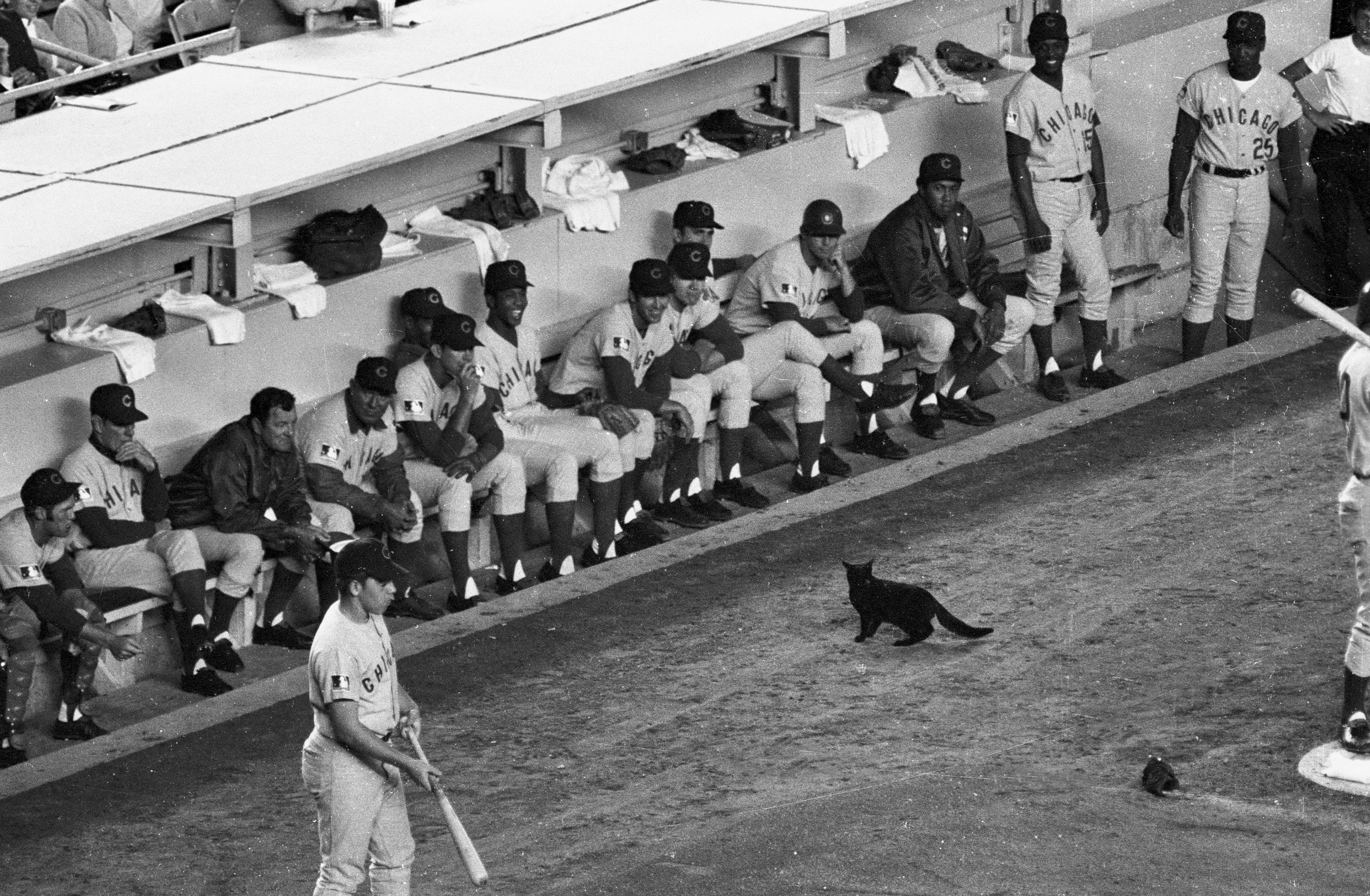
Black cat stopped the Cubs vs. Mets game momentarily in 1969. (Credit: New York Daily News Archive/Getty Images)
In the years since Sianis issued his black magic, the Cubs’ have had one of the most dismal records in professional baseball. The team still hasn’t been back to the World Series, and they’ve often ended the season near the very bottom of the National League. Fans were initially slow to blame their sputtering form on a goat, but the hex became part of club lore after Chicago sportswriters started mentioning it in their columns. Its legend only grew when the 1969 Cubs imploded after going into September with the division lead. As if fans needed any more bad omens, the downward spiral kicked off during a game against the Mets at Shea Stadium, where a black cat appeared on the field and crossed in front of the Cubs’ dugout. The team went on to miss the playoffs.
Billy Sianis officially “lifted” his goat curse prior to his death in 1970, but even he couldn’t turn the team’s fortunes around. Since then, the Cubs’ management has made several tongue-in-cheek attempts to ward off the jinx. They allowed Sianis’ nephew Sam to parade goats across Wrigley Field on several occasions, and in 2008, they even had a Greek Orthodox priest bless the diamond with holy water. Fans have also launched their own efforts to break the hex. In 2011, a group of Chicagoans formed a “Reverse the Curse” charity aimed at winning the Cubs good karma by donating goats to families in places like Africa. Another good will gesture came during the 2012 season, when five men raised money for cancer research by marching a goat named “Wrigley” 2,000 miles from Arizona to Chicago.
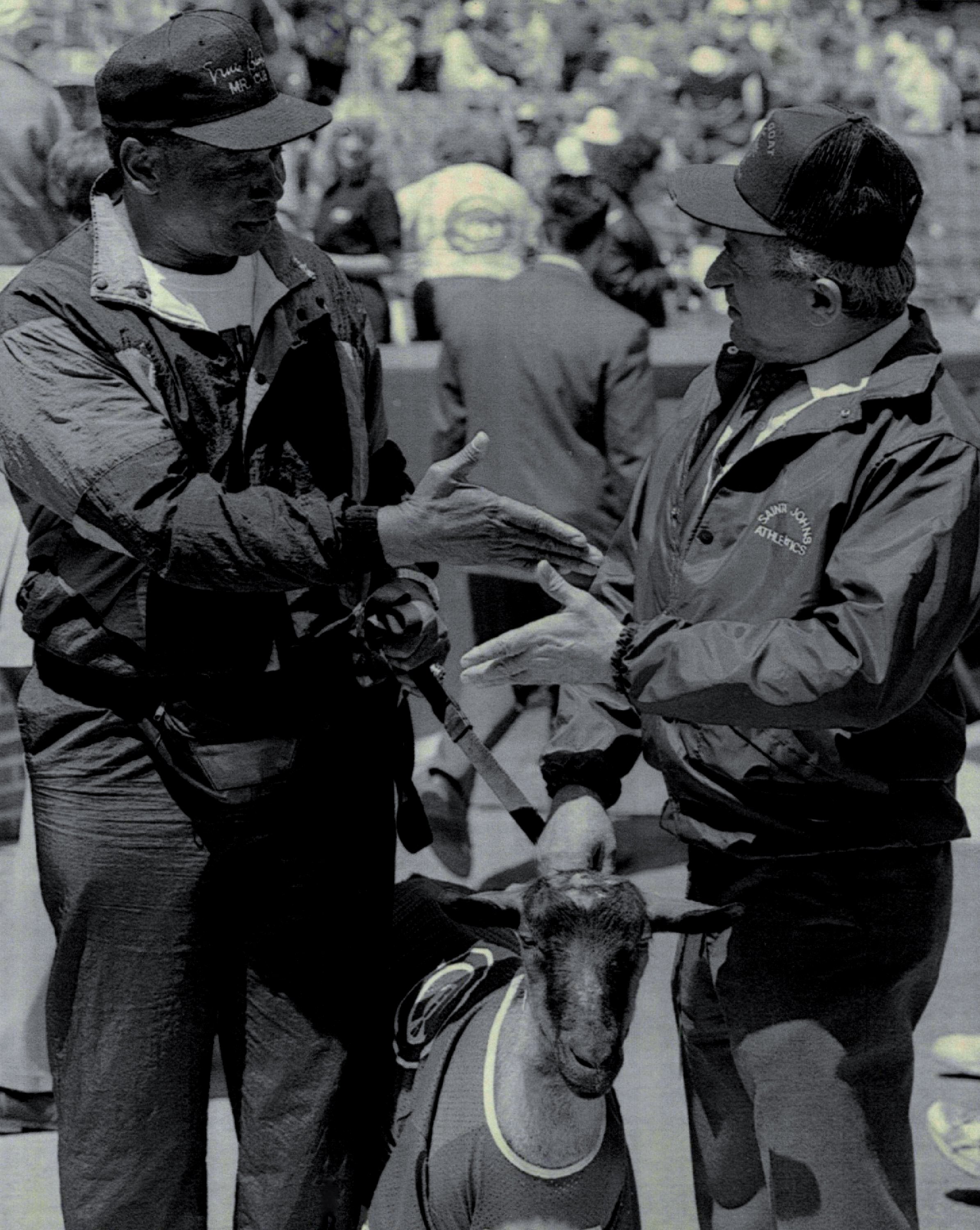
Chicago Cubs Hall of Famer Ernie Banks (L) and Sam Sianis, owner of The Billy Goat Tavern, parade around Chicago’s Wrigley Field before the start of the Cub’s game with Cincinnati Reds in 1994. (Credit: The Sporting News/Getty Images)
While some fans have tried to crush the billy goat curse, others argue that it never existed to begin with—and they may have a point. Newspaper reports from October 1945 mention Sianis and his goat being asked to leave Wrigley Field, but talk of a hex didn’t crop up until years later. According to Cubs historians Glenn Stout and Richard A. Johnson, the curse was actually a joke started by the Chicago sportswriters who frequented the Billy Goat Tavern. Sianis, always eager for publicity, simply played along.
Chicago Tribune columnist Mike Royko tried to put the issue to rest in 1997, when he wrote an article arguing that the Cubs’ real curse was P.K. Wrigley’s mismanagement and hesitancy to recruit African American ballplayers after the league was integrated. “It’s about time that we stopped blaming the failings of the Cubs on a poor, dumb creature that is a billy goat,” the column read. “This has been going on for years, and it has reached the point where some people actually believe it.”
A live goat is brought onto the field to “remove a curse” placed on the Cubs during their last World Series appearance in 1945. (Credit: Brian Bahr/Getty Images)
Even if the “Curse of the Billy Goat” is just a myth, there’s no denying that it’s been 107 years since the Chicago Cubs last won the World Series—far longer than any other club in professional baseball. The superstitions likely won’t go away until the team at least captures the pennant, but current Billy Goat Tavern owner Sam Sianis has claimed that his uncle’s jinx is no longer to blame for the Cubs’ title drought. “The hex is off,” he told the New York Times in 1989. “If they want to win, they win themselves.”
Had you ever heard of the Billy Goat Curse? Thanks for visiting and have a great week!
I just finished reading One Drop of Me by Harry Kraus and thoroughly enjoyed it. This novel opens in the present, while the main character, Lisa, is recovering from a traumatic experience. To help herself cope, Lisa starts writing a play about Sally Hemings. As the story progresses, the reader sees parallels between Lisa's life and the life of Sally Hemings. The narrative moves back and forth from the present to the past, so we get a clear picture of Lisa's day to day existence, as well as that of Sally's. This novel was hard to put down! So if you love history, as well as some great storytelling, be sure to check out One Drop of Me. With that book fresh on my mind, I decided to republish this post that I wrote back in January of 2013. Hope you'll enjoy it a second time around! The titillating television series Scandal is now in its fifth seasonon ABC. If you are unfamiliar with the show, it centers around Olivia Pope (Kerry Washington), a former media relations consultant who has the power to "fix" things for everyone. Now, she is on her own working for herself with a new law firm but has a huge scandal of her own to contend with.
While working on a gubernatorial campaign as a media relations consultant, she had an affair with then candidate, Fitzgerald Thomas Grant III (Tony Goldwyn).Now as a fixer, she is called upon to fix a scandal in the president’s office.However, the president now residing in office just happens to be Fitzgerald Thomas Grant III, and his affair with Olivia begins all over again.By the way, did I mention Olivia is black and Grant is white?
Forbidden love is nothing new in politics, but throw race into the mix and it becomes explosive! According to the Monticello website, “The claim that Thomas Jefferson fathered children with Sally Hemings, a slave at Monticello, entered the public arena during Jefferson's first term as president, and it has remained a subject of discussion and disagreement for two centuries.
“In September 1802, political journalist James T. Callender, a disaffected former ally of Jefferson, wrote in a Richmond newspaper that Jefferson had for many years ‘kept, as his concubine, one of his own slaves.’ ‘Her name is Sally," Callender continued, adding that Jefferson had "several children’ by her.” Visit the Monticello site for further factual information. The novel Sally Hemings by Barbara Chase-Raiboud provides a fascinating fictional account.
Another interesting story revolves around Vice President Richard Mentor Johnson and his mulatto, Julia Chinn. Johnson served as vice president under Martin Van Buren. He and Chinn are referred to briefly in distinguished historian Thomas Fleming’s novel, The Wages of Fame.
Undercover Blackman says, “How much of a “Negro” was Julia Chinn? Well, she was a slave… a slave Johnson inherited from his father. She was “Negro” enough that Richard Johnson couldn’t have married her legally...Yet she was his mate. His common-law wife, in effect. “ ‘She was the hostess at his Kentucky home when [French aristocrat] the Marquis de Lafayette visited,’ wrote Lindsey Apple, a retired Georgetown College history professor, in answer to questions from me.” Johnson served in Kentucky’s state legislature (1804-1806; 1819), the U.S. House of Representatives (1807-1819; 1829-1837) and the U.S. Senate (1819-1829) prior to his becoming vice president.
Richard Mentor Johnson
Abraham Lincoln made reference to Chinn in a rather non-complimentary way. He exploited Johnson’s relationship with her to score a point against Stephen Douglas during the Lincoln-Douglas debates of 1858. His words are as follow:
...I have never seen to my knowledge a man, woman or child who was in favor of producing a perfect equality, social and political, between negroes and white men. I recollect of but one distinguished instance that I ever heard of so frequently as to be entirely satisfied of its correctness – and that is the case of Judge Douglas’ old friend Col. Richard M. Johnson.
One of the most recent political indiscretions revealed was South Carolina Senator (and segregationist) Strom Thurmond’s love affair at 23 with his family’s African American maid, Carrie Butler, who was 15. Newsday mentioned in its obituary of Thurmond thatrumors flew for years in South Carolina that Thurmond, while still a segregationist, had a relationship with a black woman that produced a daughter. Jack Bass, author of the Thurmond biography Ol’Strom, says, “Thurmond never denied it, though he kept it under the rug for years...”
Thurmond’s love child from his relationship, Essie May Washington-Williams, penned her memoir, Dear Senator, in 2005. She waited until after her father’s death, at age 100, to reveal his secret. A Publisher’s Weekly review of Dear Senator explains that Carrie Butler died at 38 in a hospital's poverty ward. Although she rarely appears in the memoir, Ms. Washington-Williams “fashions her a kind of love story: ‘I knew [Thurmond] loved my mother. I believed he loved me, after his fashion.’” The love story Ms. Washington portrayed in Dear Senator provided the inspiration for my novel The Governor’s Sons, a provocative tale that examines a “politically incorrect” relationship of a young law student who falls in love with his family's hired help, a college age black girl.
Perhaps there are more forbidden love stories hidden in the annals of history just waiting to be discovered. Maybe they'll inspire more novels—or even influence a story line in a TV series.
Are you a fan of "Scandal"? Thanks for visiting and have a great week!